The moment someone writes “highly interested” in the CRM, what does the rest of the team learn—and what gets lost?
A colleague may treat the account as a priority for follow-up. But the note rarely explains why: Did the recipient reopen the document, spend time on a particular section, or click the inquiry link? It also fails to say what the next owner should verify.
The label is convenient, but it collapses an observed event and a salesperson’s interpretation into one conclusion. A useful CRM note should not rush to grade a lead. It should let the next teammate continue the conversation from the same evidence.
An email address is not proof of buying readiness
If someone submits an email address to receive a document, you have gained a contactable lead. You have not confirmed that they are ready to buy. They may be researching the market, collecting material for an internal review, or simply trying to understand the category.
The same caution applies to a completed read, a long visit to one page, a revisit, or a CTA click. These are useful inputs for follow-up, but none confirms that the account is ready to proceed, has budget approval, or involves a decision-maker. Record what happened alongside what still needs to be learned before assigning a confident label.
Build the note around five fields
CRM structures vary, but the substance of a good handoff can be organized into five fields.
-
Observed activity Record which document was opened, when it happened, how far the recipient went, and whether there was a revisit or link click.
-
Conversation and acquisition context Note how the recipient received the asset and what they said they planned to evaluate in the previous conversation.
-
Working hypotheses Keep more than one explanation open. They may be revisiting product scope, or looking for material to share internally.
-
The next question Replace a broad “Are you interested?” with a question that tests the current context.
-
Owner and timing Assign who will follow up and when. Without an owner, a stream of observations becomes an archive rather than a next step.
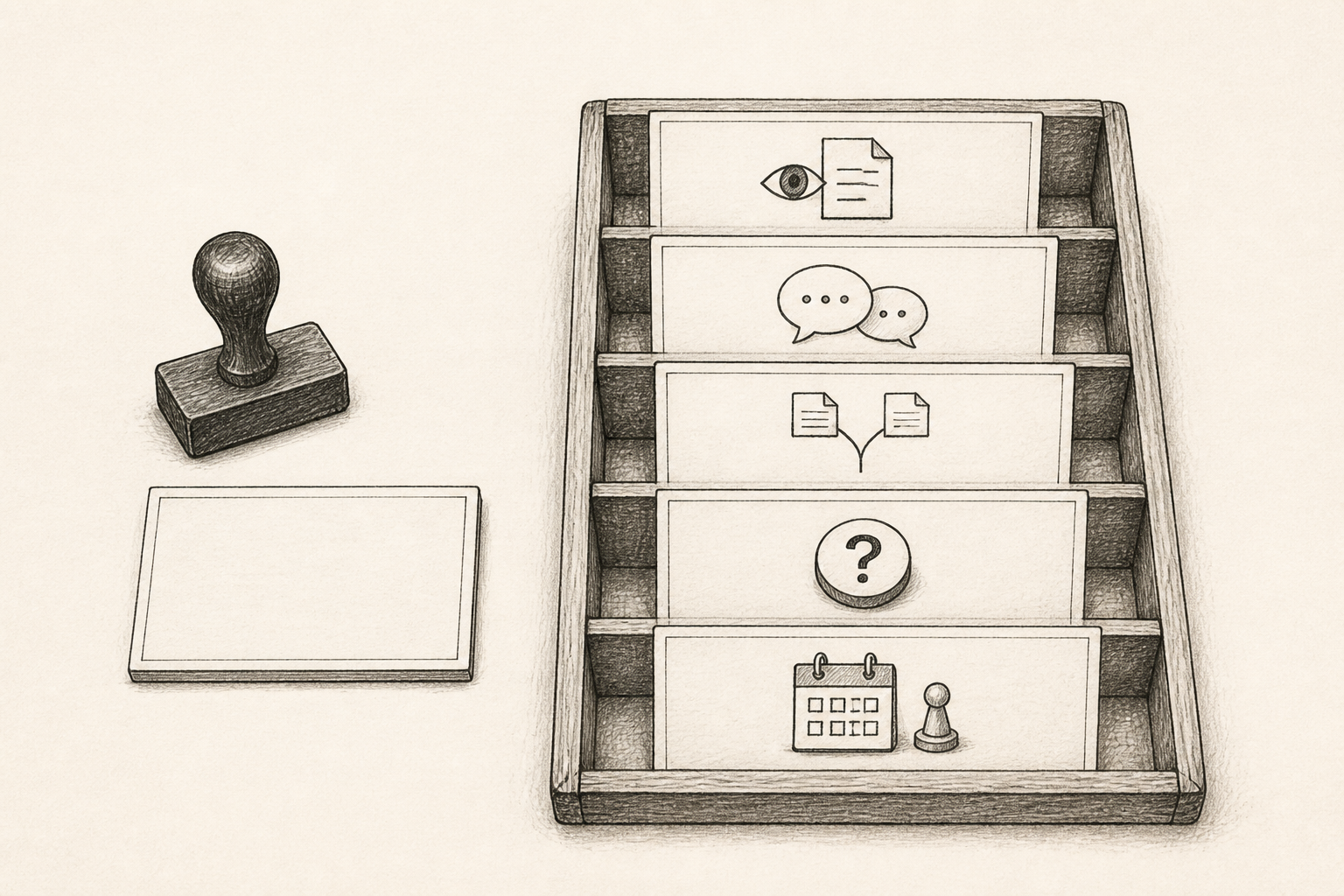
Separating the fields makes facts and assumptions visible when an account changes hands. It also reduces the chance that two teammates will interpret the same behavior in incompatible ways.
FeatPaper can supply the observed activity
When a document is shared through FeatPaper, the team can review document access, page-level viewing and time spent, revisits, and link or CTA clicks. Put those records in the observed-activity field first.
Observed: Revisited the product-scope page and clicked the inquiry link once
Context: Said on the last call that they were assembling internal comparison criteria
Working hypothesis: May be checking scope or the criteria needed for comparison
Next question: Which comparison needs more detail—features, pricing, or operating requirements?
Owner and timing: Account executive, follow up Thursday
FeatPaper can show that an action occurred. It cannot tell you why. A long visit to the pricing page does not prove that price is a concern. The recipient might have been comparing line items, preparing an internal summary, or simply left the page open.
Instead of entering “price concern” as a fact, ask whether any part of the pricing structure needs clarification.
Look for a sequence, not one dramatic signal
A completed read or a click is easy to notice. For a useful follow-up, the sequence of activity and the actual conversation may matter more.
Suppose someone first scans the overview, then returns a few days later to the scope and operating requirements. Their evaluation may be becoming more specific. That is still a hypothesis. Before raising a lead score, check whether the behavior connects to a need established in the previous conversation.
Conversely, repeated visits do not call for an aggressive proposal if the project timeline and stakeholder roles are still unclear. The better next move may be to ask where the review stands.
The goal is not to evaluate a person by the volume of their activity. It is to turn a sequence of actions into context for a better conversation.
What belongs on the final CRM checklist?
Lead scoring can help a team sort a large pipeline with consistent rules. A score alone, however, does not tell the next owner what to ask or what material to prepare. When the criteria are vague, a number can simply make a shared assumption look more precise.
Before saving the note, check that:
- Observed activity and the owner’s interpretation are separate.
- A form submission or completed read has not been treated as proof that the account is ready to buy.
- The prior conversation and acquisition context are included.
- More than one plausible explanation remains open.
- The next question, owner, and timing are clear.
Your CRM does not need a verdict on what the customer is thinking. It needs the facts confirmed so far and the question that should be answered next. That gives the team a more concrete follow-up without pretending the signals say more than they do.