Agency portfolios contain plenty of polished work. Yet clients often begin a consultation by asking again: “Have you handled a problem like ours?”, “How much of the work do you own?”, and “What does our team need to prepare?”
These questions do not come from a shortage of images. The result is visible, but the problem, agency role, chosen scope, and collaboration conditions behind it are not. A portfolio should be more than a gallery of the strongest work. It should be a map for assessing whether the working relationship fits.

Organize cases around comparison questions, not only industries
Grouping work by fashion, SaaS, or manufacturing is familiar. But clients in the same industry may face very different problems and require very different collaboration models.
Classify each case across four dimensions:
- Problem type: brand structure, product explanation, campaign production, conversion-flow improvement, and so on
- Scope: strategy, planning, design, production, or operations
- Decision role: which decisions belonged to the client and which to the agency
- Collaboration conditions: schedule, approval stages, required inputs, and constraints
The goal is not to build more filters. It is to help clients find a case close to their situation and know what they should compare before a consultation.
Put decision context before the outcome on each case card
Short case cards in a consistent order make comparison easier than one long narrative:
- The problem the client needed to solve
- The scope owned by the agency
- The central choice and why it was made
- What to inspect in the deliverable
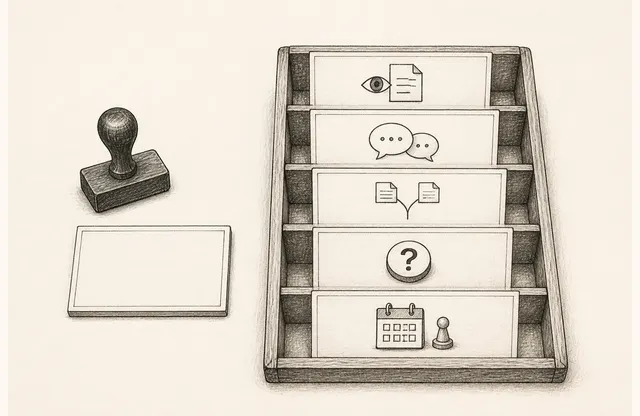
- The first question to ask in a similar project
There is no need to invent a story to fill gaps in a confidential client name, internal context, or outcome metric. For an anonymized case, keep only the verifiable problem and scope. Without outcome evidence, explain what the work was designed to help people decide rather than claiming that it increased conversion.
Do not assume one final image represents the entire process. Add evaluation context such as “a project that began by restructuring the brand” or “campaign variations created within an existing design system.” Clients can then compare the work with their own constraints.
Explain boundaries instead of listing strengths
Clients need to understand what an agency does not own as clearly as what it does well. “We handle everything from strategy through operations” is less useful than a specific account of the responsibilities and client inputs required in each project.
Explain whether the agency produces design while the client supplies copy, whether research and development are separate scopes, and how the approval structure affects the schedule. These boundaries are not admissions of weakness. They align the assumptions behind pricing and timing.
Separating “what was made” from “how we worked together” also prevents clients from confusing aesthetic preference with operational fit.
Connect the consultation CTA to the remaining evaluation questions
A generic “Contact us” button at the end of a portfolio does not tell a client what to prepare. Place a short checklist before the CTA:
- The problem and current state
- Required deliverables and their intended use date
- Internal owner and approval structure
- Existing brand or technical constraints
- Preferred schedule and scopes that need separate discussion
This is not an automated quote or a way to score contract likelihood. It is a preparation list that keeps the first conversation from missing important conditions.
Viewing records order questions; they do not prove preference
FeatPaper supports sharing a portfolio by link and reviewing signals such as visits, time spent by page, and interactions. Individual viewing records can also provide observations such as revisits, pages viewed for longer, and link clicks for follow-up work.
But a page viewed for longer is not proof of style preference, and a revisit is not proof of purchase intent. A reader may need more time for small text or may reopen the document for internal sharing.
Instead of asking, “Did you like this style?”, ask, “Which part of the scope or collaboration model in this case would you like to examine further?” The record does not provide the answer; it helps order the questions.
Check whether service fit is visible before sharing
Before sending the portfolio, confirm:
- Cases are organized in the client’s problem language.
- Agency and client roles are separated.
- Each outcome image includes the choice and constraints behind it.
- Confidential client details and unsupported outcomes are excluded.
- The CTA asks about project scope and collaboration conditions.
- Viewing records are not treated as preference, lead score, or contract probability.
A useful agency portfolio is not the document that displays the most work. It lets a client place their own problem and required roles into the cases, then ask whether the way of working fits beyond the visual result.