Monthly client reports often contain every campaign metric, table, and screenshot. Yet the next meeting may still begin with, “What actually changed since last month?” The problem is not missing information. It is that changes and decisions are not connected in the same sequence.
A report should do more than prove that work happened. It should help the client and agency review what changed, the evidence behind the interpretation, what remains unresolved, and who owns the next step using the same frame.

Use the first page to answer what changed
Instead of filling the first page with metrics, define the scope of this review. State the baseline period, comparison period, included channels, and exclusions, then select two or three material changes.
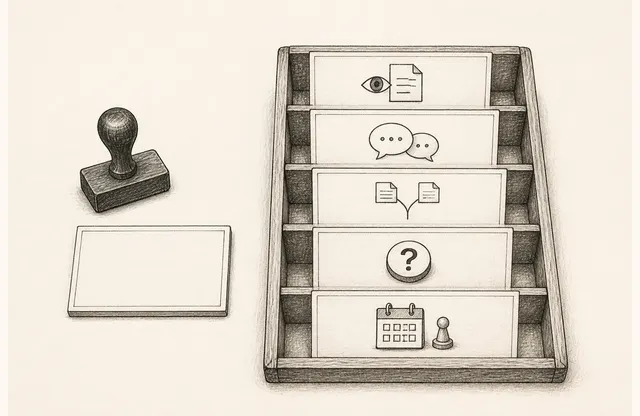
Organize each change into four fields:
- Change: What observable value or state changed?
- Evidence: Which period and source support it?
- Meaning: What decision does the team propose now?
- Open question: What still needs to be checked before deciding?
An increase in visits to a piece of content is not the same as proof that the content drove revenue. The former can be observed; the latter requires separate evidence. Without that evidence, keep it as a question for the next review rather than upgrading it into an outcome.
Separate results, interpretation, and recommendations
A report can feel defensive even when the result itself is not poor. When results, interpretation, and recommendations appear in one sentence, readers cannot tell where fact ends and judgment begins.
Attach the measurement period and data source to tables and charts. Record assumptions and exclusions beside the interpretation. For recommendations, list the available actions and the criteria for reviewing them. Separating these layers lets the client examine the quality of the judgment, not only the number.
A strong sentence does not create more certainty than the evidence allows. “Time spent on this page was longer than in the previous report, and we will check message comprehension in the next interview” is easier to review than “The response was positive.”
Turn unresolved questions into next actions
A monthly report is not expected to settle every cause. Accurately recording what remains unknown makes the next month’s work clearer.
For each open question, add:
- The question to confirm
- The evidence required
- The owner
- The date to revisit it
“Improve the creative” only recreates the same discussion next month. Connect the proposed change to the assumption being tested and to the metric or interview that will be reviewed. For deferred items, record why they were deferred and what condition will reopen them.
Use one reference link to reduce version confusion
When monthly reports circulate as repeated email attachments, the client and agency can easily discuss different versions. In FeatPaper, a document can be updated while retaining its existing link, and analytics for previous versions remain available. If page count or layout changes, interactive element placement should be checked again.
This is not automated reporting or automated performance analysis. The purpose of the reference link is to simplify distribution and make the version under review clear. The report should still show its revision date and a short change summary so readers do not have to infer version meaning from the link alone.
Viewing records prioritize explanations, not customer satisfaction
FeatPaper document analytics can show signals such as visit count, time spent by page, and page interactions. These records may help decide what to explain again, but they do not prove that the client was satisfied or intends to renew a contract.
If a page was revisited, replace “Why were they interested?” with “Which question should we confirm first in the next meeting?” Check whether internal views were mixed in and whether the comparison uses the same period and document version. Separating observation from interpretation keeps viewing records useful for a more accurate conversation rather than turning them into inflated outcomes.
Check the decision flow before sharing
Before sending the report, confirm:
- The first page shows the period, scope, and key changes.
- Every important figure has a source and comparison baseline.
- Results, interpretation, and recommendations are separated.
- Open questions are connected to required evidence and an owner.
- Next actions include a review date.
- The revision date and change summary match the current version.
- Viewing records are not interpreted as satisfaction, performance, or contract intent.
A useful monthly client report is not the report with the most charts. It shows how the judgment changed, keeps that judgment tied to evidence, and hands what remains unknown to the next owner. That lets the next meeting begin by preparing the next decision rather than defending the previous report.