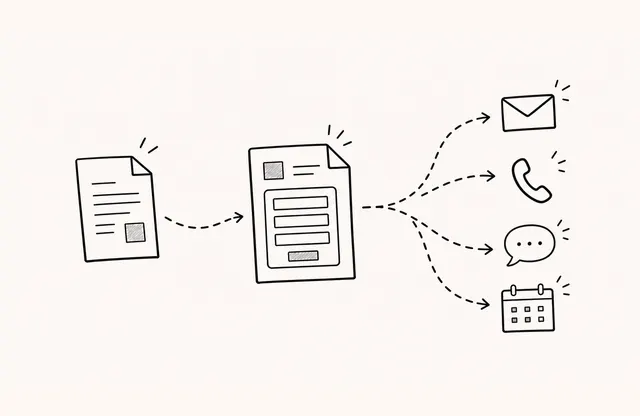
The moment a marketing PDF is attached to an email, it starts to multiply.
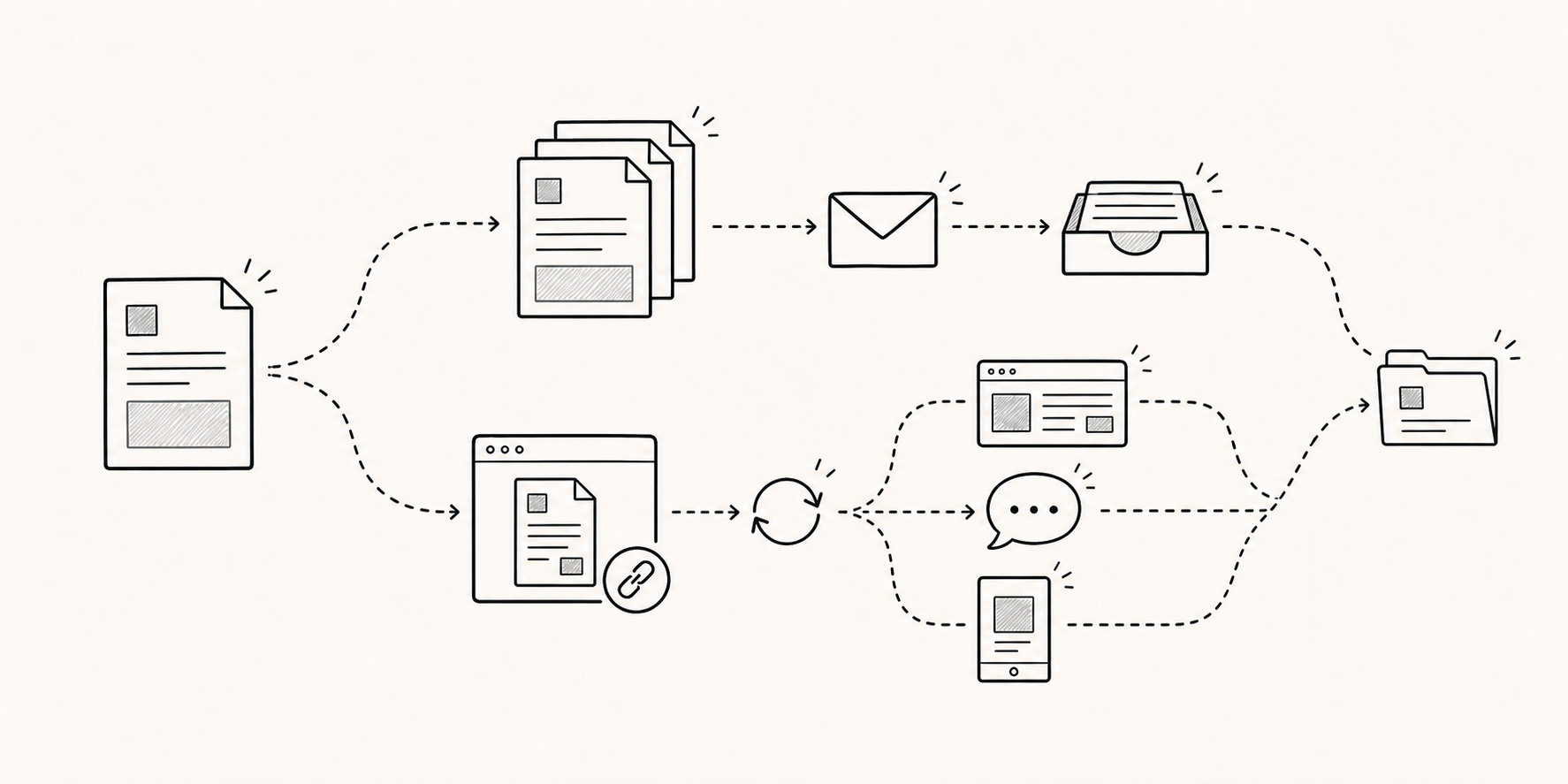
One copy stays in the inbox, another lands in a downloads folder, and more appear as recipients forward it to colleagues. If the sender corrects a typo or updates a price table, the old and new files can remain in circulation at the same time.
File size is the visible problem. The longer-lived problem is not knowing which version people are reading after the send.
That does not mean every PDF should become a link. A contract may need to preserve exactly what was agreed at a given moment. A company deck or white paper may continue to change and travel across several channels.
The better question is not simply, “Attachment or link?” It is what the document needs to do after it leaves the sender.
An attachment preserves a point in time
An attachment makes sense when the recipient must own the file or keep the exact state in which it was delivered. Final contracts, formal submissions, settlement documents, and approved reports are common examples.
The original file may also be necessary when recipients need offline access or must register it in an internal document system. In these cases, the job is not to keep changing the material. It is to hand over a complete record and preserve it.
If the recipient needs to own and retain “this file,” start with an attachment.
Attachments are not the problem. Version drift begins when a document that keeps changing is repeatedly distributed as a fixed copy.
A link points to the current reference
Company decks, product brochures, sales materials, white papers, campaign reports, and partner guides rarely stop working after the first send. Features and pricing change. New examples are added. Several team members may reuse the same material in email, newsletters, websites, messaging apps, or QR codes.
A link allows those touchpoints to point to one current version. In FeatPaper, a new PDF can replace the document while the existing URL remains the same. Analytics for earlier versions are retained by version. If the page count or layout changes, interactive elements should be checked and repositioned where necessary.
The value of link sharing is not that a URL replaces a file. It is that documents with the same purpose can be managed as one current reference.
Five questions clarify the choice
Before sending a document, use these five questions to separate the roles of an attachment and a link.
| Question | An attachment fits better when | A link fits better when |
|---|---|---|
| What must the recipient do? | Save, submit, or archive the file | Review the content and decide what to do next |
| Is the document likely to change? | This is the final version for that moment | Features, prices, examples, or dates may change |
| Where will it be read? | Mostly on desktop or in an internal system | Across mobile, email, messaging, and the web |
| How broadly will it be distributed? | Once, to a defined small group | Repeatedly, by several people and channels |
| What matters after sharing? | No information beyond delivery is required | Viewing flow and link interactions may help improve the document |
The answer can change as the document moves through its lifecycle. A sales deck may stay on a link while terms are under discussion, then become a fixed PDF when the final scope is agreed. A public report may open directly on the web while still allowing readers to download the original PDF.
Attachments and links do not have to replace one another. They are two delivery methods with different jobs at different stages.
Inbound distribution needs context around the link
In inbound marketing, creation and distribution are part of the same job. A company deck appears on the website and in sales emails. A white paper is linked from a newsletter and a campaign page. Event material may return in invitations, on-site QR codes, and follow-up messages.
One reference link reduces the number of places where a revision must be replaced. But a bare URL still leaves the reader guessing. A short introduction should explain:
- what the document is;
- where the reader should begin; and
- what they can do after reviewing it.
Instead of “Please review our company deck,” try something more useful:
This is the current company deck for review. Pages 4–6 cover the main use cases, and page 9 outlines the implementation process. If anything needs clarification, reply to this email or use the contact option in the document.
A good link still needs a good document. The first screen should make its purpose clear, text and tables should remain legible on mobile, and readers should be able to find the relevant section and contact path. A link changes access; it does not repair weak information architecture.
Keep one link for one purpose
Correcting a typo or adding a current example usually belongs on the same reference link. The following changes are signs that a separate document may be clearer:
- the target account, audience, or industry has changed;
- the range of information that can be shared is different;
- the campaign goal or commercial terms are different;
- an earlier version must remain as a formal record; or
- the decision expected from the reader has changed.
A general company deck and an account-specific sales document should not overwrite each other. Nor should a public brochure and a partner document containing pricing or security details share one reference by default.
Good version management does not mean forcing every variation into one document. It means keeping one current reference for one purpose and separating documents whose purpose has changed.
Use viewing data to improve the document first
A linked document can record visits, time spent by page, revisited pages, and clicks on links placed in the document. Those records help teams understand what happened after sharing, but they do not reveal buying intent or confirm comprehension.
A long visit to one page may reflect interest, or it may mean the explanation was difficult. A return visit may be preparation for an internal discussion, or simply another attempt to find a detail.
Use an individual reader’s record to choose a better follow-up question. Use patterns repeated across readers to improve the document first. If people consistently leave at the same page, check whether the key message appears too late, the table is hard to read on mobile, or the next step is unclear before blaming a lack of interest.
The data is not a verdict on the reader. It is material for making the document and the next question less vague.
A practical setup changes by document stage
Company decks and product brochures
Share early-stage materials as a link and keep current features and examples in one reference. If some readers need a file for internal storage, the document setting can allow them to download the original PDF from the viewer.
Sales materials
While the scope is still being discussed, keep revisions on the link. When terms are final, send a fixed PDF as the record of what was agreed.
White papers and reports
Offer a link for immediate reading and a download option for readers who need long-term storage or internal circulation. If the distribution program needs to distinguish readers, consider a pre-view lead form that asks only for necessary fields such as email, name, or company. Not every public resource needs a form.
Contracts and formal submissions
A link or collaboration environment may support the review stage, but the signed or submitted version is usually better retained as a file.
Should every PDF become a link?
No. Use an attachment when the point-in-time record must be owned and retained. Use a link when the same current version needs to stay available across updates, people, or channels.
Does updating a link erase earlier analytics?
FeatPaper manages document analytics by version and retains data for earlier versions. When a new version changes the page structure, verify that existing interactive elements still sit in the right places.
Can a linked document still offer a PDF download?
Yes. A per-document setting can allow or restrict downloading the original PDF from the viewer. This controls the download option in the viewer; it should not be described as preventing screenshots or every other form of copying.
Does a long or repeated visit signal buying intent?
Not by itself. Time spent and repeat visits are observable actions. The reasons still need to be asked. Use those records to improve the document and prepare a more relevant conversation.
Pre-send checklist
- Is this a point-in-time record or a current reference that will keep changing?
- Must the recipient own the file, or only review its content?
- Will several people or channels reuse the same material?
- If it is a link, are the title, opening screen, mobile layout, and contact path clear?
- Has the document’s purpose changed enough to require a separate link?
- Does the team have a rule against treating viewing records as customer intent?
An attachment hands over one moment in a document’s history. A link gives the reader a path to the current reference.
Rather than insisting on one method, attach the documents that must be handed over and manage as links the documents that must keep being read and revised.
What still needs native review?
An English reviewer should confirm the distinction between a formal record and a working reference, as well as the tone of the examples and CTA. Product behavior and indexing remain gated until owner review is complete.