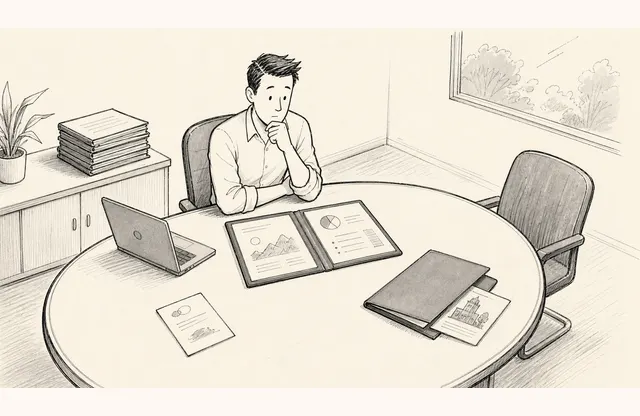
Investor materials multiply quickly after the first meeting. A financial scenario is added to the introductory deck; technical and security questions produce new appendices. Once several versions are scattered across email and messaging threads, neither side can be certain which one should anchor the discussion.
The answer is not one enormous document. It is one current source of truth, supported by the appendices and questions needed at each review stage.
Match the material to the review stage
At first contact, the main deck only needs to frame the problem, market, product, team, and core assumptions. After the first meeting, add revenue-model or execution detail. Separate financial, technical, and security appendices when deeper review begins.
Sending every appendix at once makes it harder to tell whether a long session reflects interest or simply the effort of finding the right page. Keep the company story in the main deck and give each appendix one clear review purpose.
Make one link the source of truth
Files named final.pdf, final_v2.pdf, and final_July.pdf leave different versions in different inboxes. With FeatPaper, a team can update the PDF behind an existing shared link. If the page count or layout changes, recheck the placement of videos, buttons, and other interactive elements.
State the update date and changed assumptions in the document or accompanying note. Keep the link when the investor and review purpose remain the same; create a separate link when the audience, purpose, or access boundary changes.

Match access to the review stage
An introductory deck may need to open with little friction. An appendix containing customer-level revenue, financial projections, or product architecture may require a narrower audience. Depending on the document, teams can limit access to approved email addresses, set an access window, control downloads, or stop sharing.
These controls manage access; they cannot prevent every form of capture or redistribution. Apply the company’s legal and security approval process to sensitive material as well.
Use viewing records to prepare questions
Page views, revisits, and link clicks describe activity, not intent. A market-size page may have been revisited because the methodology mattered—or because it was unclear. Time on a financial page does not prove that an investor is considering terms.
Turn the observation into a question instead of announcing that you watched it:
- Market-size page revisited: “Which assumption would benefit from more evidence?”
- Financial page viewed for longer: “Should we start with the conservative, base, or expansion scenario?”
- Technical appendix opened: “Who will join the review, and what material would be most useful?”
The investor’s answer and the meeting notes should determine the next document, not the viewing record alone.
Checklist: five decisions before sharing
- What question must this material answer?
- What belongs in the main deck, and what belongs in an appendix?
- Who owns the current link and communicates an update?
- Who should have access, and for how long?
- Which business assumption should the next meeting test?
With these decisions in place, the review path stays clear even as the material changes.
What a revisit can—and cannot—tell you
Good investor communication is not about maximizing view counts. It gives investors the material they need now and helps founders decide what to clarify next.
A revisit is not evidence of investment intent. It is a useful place to begin the next question. For a closer look at turning page activity into follow-up, read What to Ask After an Investor Lingers on a Page. For version management, see Rules for updating a shared document link.