A business card tells you a visitor’s name, company, and title. It rarely tells the next sales rep which product started the conversation, what the visitor asked, or when the team agreed to follow up. Those details remain in a hurried note or in the memory of the person who staffed the booth.
Post-event catalog activity has the opposite limitation. A return visit to a product page may be useful context, but it is difficult to interpret without the conversation that came first. A strong trade show follow-up connects the booth conversation, the material shared, and later document activity without treating any one signal as the answer.
This article is for field sales, event marketing, and revenue operations teams that need to hand off many short booth conversations after a trade show.
Capture four facts at the booth
A booth conversation is not the right moment for a long qualification form. Capture only enough context to restart the conversation:
- Which product or problem did you discuss?
- What question did the visitor ask in their own words?
- Did they request another document or a follow-up?
- When should the team respond, and what should it bring?
Labels such as “high interest” or “promising lead” are easy to scan, but they do not tell the next rep what to say. A note such as “asked whether the product works with existing equipment” is more useful because it preserves an observed fact.
A QR code does not replace the business card
A booth QR code lets visitors reopen the mobile material after they leave. A scan alone does not provide a contact or show that someone is ready to move forward. Someone may have opened the catalog out of curiosity, saved it for a colleague, or tested the code at the booth.
If contact information is required, decide why and when to request it. A public catalog may show the material first and offer a contact path afterward. A limited technical document may require a different handoff. The choice should follow the purpose of the event and the material, not a blanket definition of every scan as a lead.
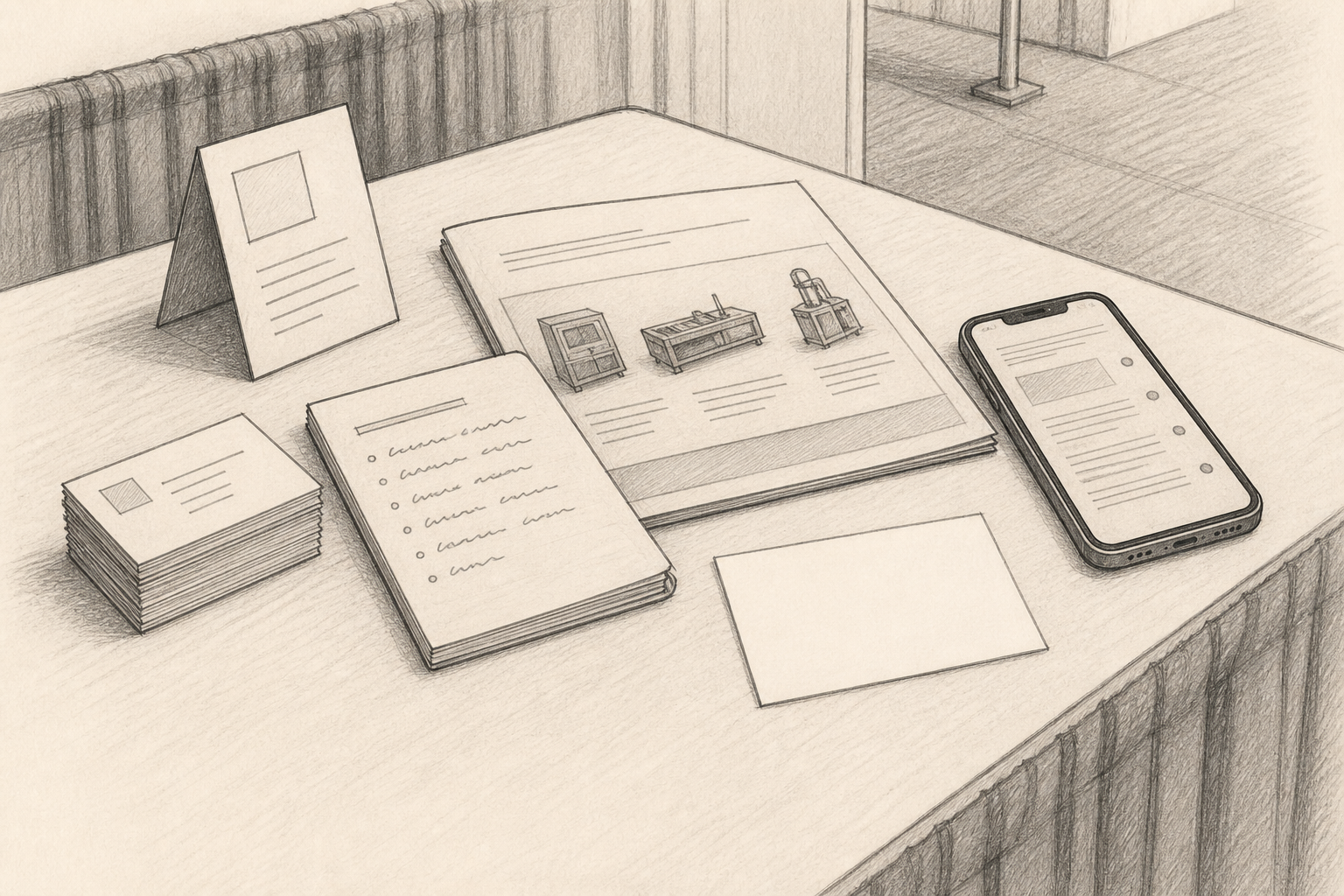
Use FeatPaper activity as context
A PDF product guide or catalog shared through a FeatPaper link can be opened on mobile without requiring a file download first. After the event, the team can review document access, pages viewed, repeat visits, and clicks on connected links.
That activity does not replace the booth conversation. It shows whether the material continued to be used. When there is a valid basis for connecting a visitor to the activity, the follow-up can continue the earlier question instead of opening with “Did you read the catalog?”
You asked about the installation environment at the booth. As you reviewed the material, did any additional conditions come up?
Do not match an unidentified viewer to a business card by assumption. Even when identification is available, viewing activity is an observation for preparing a question, not evidence of why the visitor returned.
Combine three records in one note
Keep three items distinct in the CRM: what the visitor said at the booth, which material was shared, and what post-event activity can be verified.
Asked about compatibility with existing equipment. Shared the mobile product guide. The related specification page was viewed after the event. Confirm the equipment model and installation environment in the next call.
The note does not grade the visitor. It tells the next owner what is known and what still needs to be confirmed.
Follow-up checklist: start with a question
Sending every visitor the same catalog and introduction discards the value of the booth conversation. Before following up, check that:
- The visitor’s question is recorded in specific language.
- Contact details are separate from the rep’s assessment.
- The material shared at the booth is named.
- A scan or page view has not been treated as a decision to proceed.
- There is evidence before connecting activity to a specific visitor.
- The next question and owner are clear.
Trade show follow-up is not only about the number of cards collected. It is about preserving a short booth conversation and carrying it, together with the document activity that followed, into a relevant next question.