You send a pitch deck after an investor meeting. The next day, the viewing record shows a quick pass through the market slide, more time on traction and the financial plan, and another visit a few days later.
The tempting conclusion is that the investor cares most about traction or has concerns about the model. But the record only shows which pages were reached, how long each page stayed open, and whether the deck was revisited. It does not explain why, and it does not reveal investment intent.
Pitch deck analytics are most useful as preparation for the next conversation: they help you choose which assumption to clarify first.
Read each slide as an assumption
Before sharing the deck, write down the question behind each major slide.
The problem and market slides ask whether the pain is urgent and the opportunity is large enough. The product slide asks whether the approach works and is meaningfully different. Traction asks whether growth is repeatable and healthy. The business model and financial plan carry assumptions about revenue, cost structure, runway, and use of funds.
It also helps to separate the core deck from a short internal summary and detailed financial or technical appendices. Then a long view can be considered in the context of the investor’s review stage, not treated as a self-explanatory signal.
Keep more than one explanation in play
Suppose the investor spends longer on the traction slide. The metrics may be important to the decision. The definitions or comparison period may be unclear. The investor may be checking the numbers against meeting notes—or may simply have left the page open.
A revisit is just as ambiguous. It might reflect interest, confusion, internal sharing, or fact-checking. Keeping at least two plausible explanations prevents the follow-up from sounding like a verdict about the investor’s behavior.
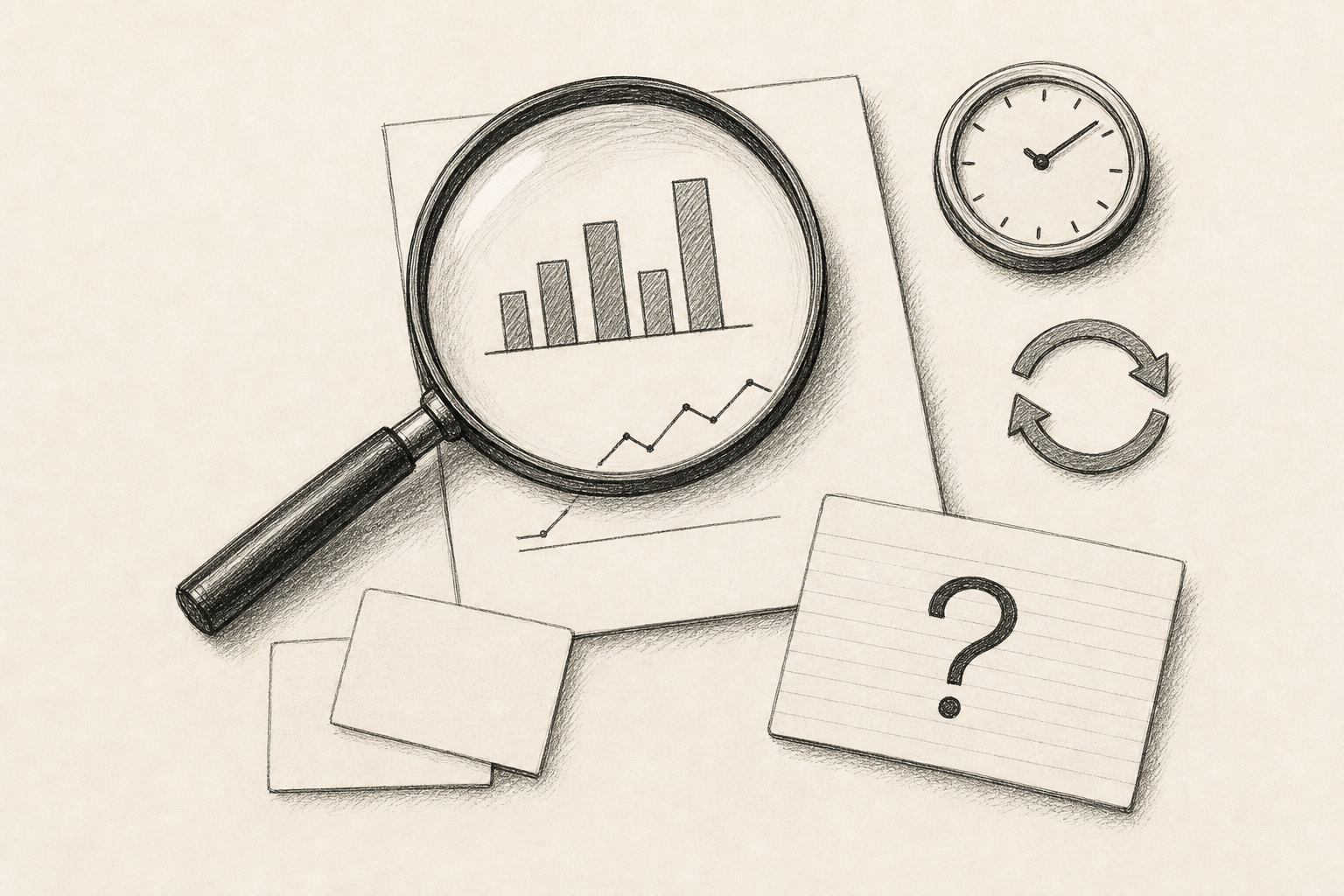
What should the four-line checklist include?
The follow-up plan can be compact:
- Observation: Which slide was reached, how long was it open, and was it revisited?
- Possible explanations: List at least two, such as interest, confusion, or verification.
- Question: What is the one thing to ask directly in the next conversation?
- Supporting material: Which single slide or appendix would help answer it?
Instead of saying, “You seem very interested in our traction,” ask, “Which part of the growth story would be most useful to examine next: retention, customer concentration, or repeat purchases?” The question gives the investor room to state the actual review criterion.
You do not need to disclose the viewing record. Rather than saying, “I noticed you spent a long time on the financial slide,” ask, “For our next discussion, should we start with revenue assumptions, the cost structure, or runway?”
Treat FeatPaper data as context, not a score
When a pitch deck is shared through a FeatPaper link, the team can review document visits, page-level views and viewing time, and link clicks. Where appropriate, the document can also be limited to permitted email addresses, given a viewing period, and configured to allow or restrict downloading of the source file.
None of that produces an investment-likelihood score. A long view or a revisit cannot tell you whether a partner meeting has happened, whether the investor intends to proceed, or how much they might invest. Combine the record with meeting notes and questions from email. When the same issue appears in both places, you have a reason to strengthen the explanation. When only the viewing record exists, prepare a question rather than a conclusion.
Revise the deck when questions repeat
Changing the entire deck after one investor’s session can turn an accidental behavior into an editorial decision. A stronger signal is repetition: several investors ask how a metric is defined, and the same slide is repeatedly revisited.
Even then, the goal is not a higher completion rate. Clarify the date and calculation behind a number, keep the main slide focused, and move detailed evidence to an appendix. The point is to reduce the effort required to evaluate the business.
Before the next meeting, check three things: what you actually observed, whether you kept more than one explanation, and what a single question can confirm.
Good IR follow-up is not mind-reading. The slide an investor spent time on is not an answer; it is a useful place to begin a more precise conversation.