A reader finishes a case study. Should the next destination be a proposal or a pricing guide? Many teams turn this into a button-copy question: whether “Learn more” is weaker than “Get a quote.” But even clear copy will not continue the review if the destination does not match the question the reader still has.
The end of a document is not merely a place to push an action. It connects what the current document has answered with what remains unresolved. Choose the next document by the evidence the reader needs to keep evaluating, not by a fixed sales-stage sequence.
Start with the question the current document has answered
A case study is useful for answering, “Could an organization like ours solve this problem?” A proposal can address, “What scope and approach would fit our situation?” A pricing guide can help someone ask, “Can we evaluate this cost structure?” Documents with the same name can still play different roles from one team to another.
Before designing a path, summarize the current document in one sentence: “What decision does this document help the reader make?” If the answer is vague, choosing the next document will also be difficult. If one document briefly mentions examples, delivery, and pricing, the reader may need depth on one point rather than another summary.
Choose a destination from one remaining question
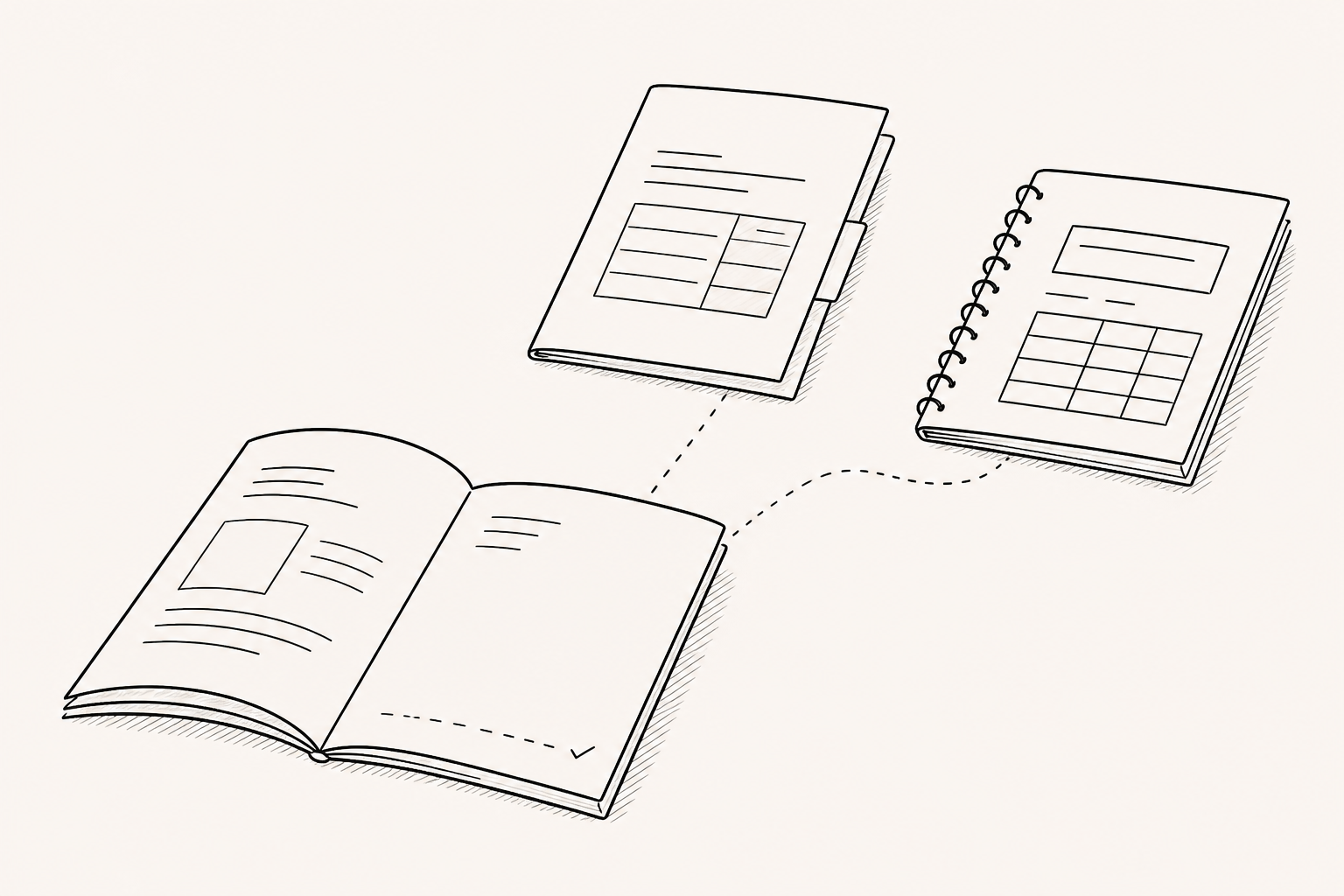
A practical criterion is the largest question that remains after reading. A proposal does not always have to follow a case study. If implementation effort is the concern, an operations or technical guide may come first. If budget range is the issue, pricing information is a natural destination. If the reader needs internal support, a more specific case may be more useful.
“Case study → proposal → pricing” is therefore one possible path, not a standard one. The remaining question can differ depending on whether a salesperson sent the case study after a first meeting or a website visitor found it independently. Keep only a few representative paths for common entry contexts, then choose from the reader’s actual starting point.
Keep the choices few and the reason for moving clear
If the end of a case study offers a proposal, price sheet, company profile, newsletter, and meeting request all at once, the reader has to calculate the priority again. Keep one primary route. Add a secondary choice only when a distinctly different direct action is genuinely necessary.
“View the proposal” names a destination but not the reason to go there. “Review the scope that could apply to your organization” reveals the next question. Similarly, “Review the range needed for budget evaluation” connects more directly than “See pricing.” Copy is not an exaggerated persuasion device. It is a signpost promising what the destination will clarify.
Check whether that promise is kept immediately after the click. If the next document’s title and opening address a different issue, the reader loses context during the move. Unlike a table of contents that navigates within one document, this check asks whether two separate documents continue the same decision.
Leave one operating sentence for every route
Four fields are often enough to review a path: current document, answered question, remaining question, and next destination. Add an owner and a review trigger so people know whom to ask when materials change.
For example: “Manufacturing case study / Can a similar organization apply this approach? / What are our scope and schedule? / Proposal scope guide / Owner: Sales Operations.” When the proposal scope changes or a new case is added, the owner reviews whether the connection still fits. A working link does not prove that a route is still useful.
If the destination is retired or its role changes, update the connection as well. Do not add every new asset to the existing path. Compare whether it answers the remaining question more precisely, and replace one destination when appropriate. This record preserves why the reader’s decision can continue; it is not just a link list.
A move is context for the next conversation, not intent
Do not treat movement between documents as purchase intent. A click or view is only an observed signal that another resource may have been needed; it does not prove budget, authority, or likelihood to contract. If the path calls for follow-up, start by confirming what question remained.
The final element should not be the strongest possible CTA but a clear connection: “This document answered this question; the next document addresses that remaining question.” When that sentence feels natural, readers can continue their own review instead of following a sequence imposed by the seller.