Even when the document is the same company overview, the distribution context can be different. Some materials are meant for anyone visiting a website. Others are sent to one person who has already agreed to a consultation. Sometimes contact details are genuinely needed before someone reads. In other cases, asking for a name creates friction without serving a clear purpose.
Choose a link type by answering operational questions, not by comparing feature lists. Who should be able to view the document? How public can it be? Does the follow-up workflow need to distinguish recipients? What data is needed, and why? Who owns the next action? Once these five points are clear, the appropriate link type becomes easier to narrow down.
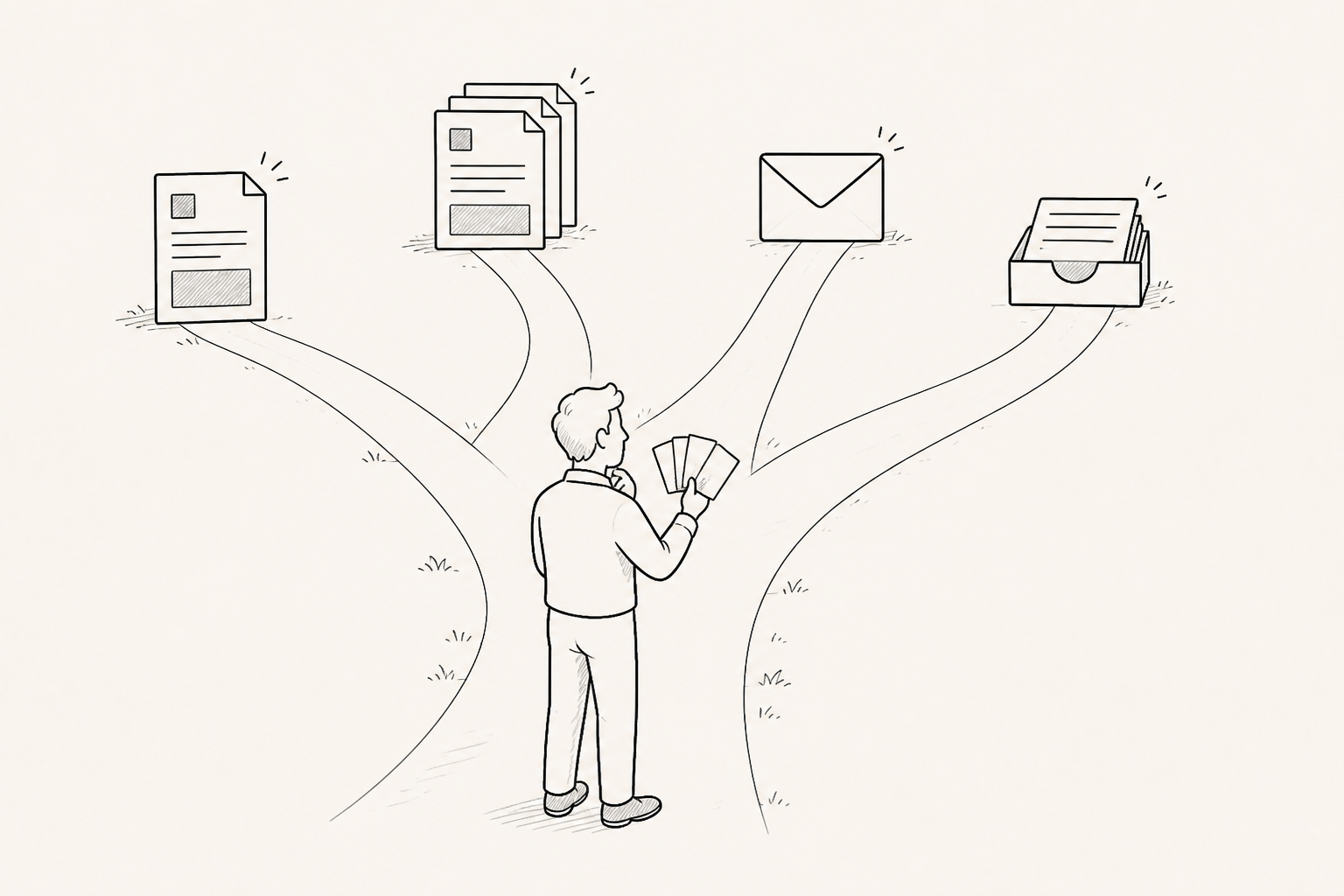
Use a General Link When the Material Can Be Shared Broadly
A general link fits situations where the document is not limited to one named recipient. Post-event reference material or a company overview for a broad audience are typical examples, especially when there is little reason to ask for information before the document opens.
The important point is not to assume that you know who opened the link. Set the document’s exposure boundary with the possibility of forwarding in mind. You can set a viewing period when access should be limited to a certain window, but that setting should not be described as an absolute security or access-prevention guarantee.
Start With Why You Need the Data Before Using an Information-Request Link
An information-request link can be considered when you need to ask for specific details before the document opens. Start by recording the purpose of the data, not the list of fields. If you request an email address, explain who will use it and for what follow-up. If you request a company name, state which operational classification requires it.
Adding a form to every document is not a sound default. If the reading barrier increases but no one is responsible for using the collected information, only the input step remains. Keep only the fields you actually need and assign the follow-up owner first.
Use an Individual Tracking Link Only for Recipient-Specific Follow-up
An individual tracking link can be considered when a consultation relationship already exists and the owner needs to prepare follow-up questions for each recipient. What it provides is not an identity guarantee, but a way to distinguish individual sends and connect them to the follow-up workflow.
Even when links are issued separately, you cannot conclude that the person who opened a link was necessarily its original recipient. Explain the possibility of forwarding and the applicable sharing rules. Treat viewing records as observations that help the owner prepare questions, not as proof of purchase intent or agreement.
Choose an AI Public Link Only After Public Access Is Approved
Before choosing an AI public link, decide whether the material is suitable for an unspecified public audience. The word “AI” in the link type does not promise search exposure or citation by an AI system. First confirm that the information is approved for external release, identify who maintains the current version, and assign responsibility for closing or updating the link when information becomes outdated.
If one document mixes customer-specific pricing, confidential contract terms, or unapproved product plans with public information, separate the document before choosing a link type. Trying to solve different exposure and update responsibilities with settings alone leaves the operating boundary unclear.
Record the Decision in a Five-Field Matrix
Before creating a link, record one row of decision context.
| Field | Question to record |
|---|---|
| Audience | Is this for an unspecified audience, a defined group, or one person? |
| Exposure | Can the content be shared even when forwarding is considered? |
| Identity | Does the follow-up workflow truly need to distinguish recipients? |
| Requested data | What information is requested, why is it needed, and who will handle it? |
| Follow-up owner | Who owns questions, updates, and closure? |
For a general link, the identity and requested-data fields may be empty. For an information-request link, every requested field needs a purpose and owner. For an individual tracking link, each send needs to connect to a recipient-specific follow-up owner. For an AI public link, public exposure needs approval and the current version needs an owner.
Manage the Reason for the Choice After You Send the Link
Do not record only the link type in your link register. Include the document name, audience, creation date, viewing end date, owner, and closure condition. If the purpose changes, do not automatically reuse the existing link; review the decision against the new conditions. When a public document becomes recipient-specific or the requested data expands, reassess the document content and the accompanying notice as well as the link type.
A good choice is not the link that collects the most information. It exposes only what the distribution purpose requires, distinguishes recipients only when the workflow needs it, and assigns ownership for requested data and follow-up actions. Complete the five fields before creating the link, and the team can explain why this distribution uses a particular link instead of defaulting to the one it always uses.